
Same nodes, better antennas
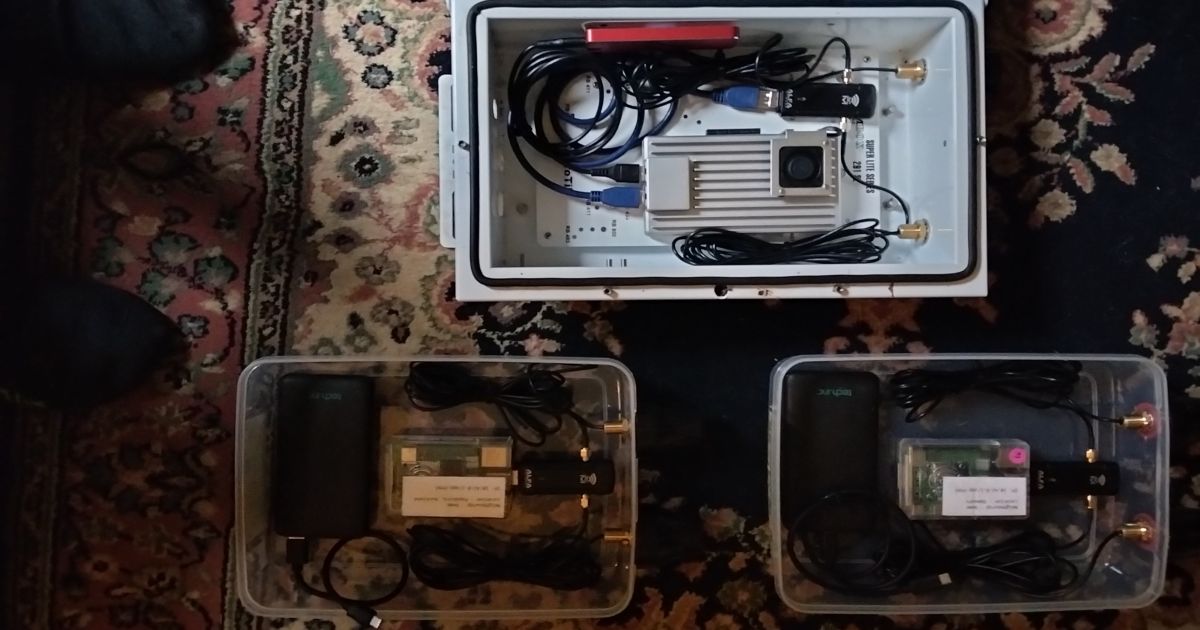
Last time we reported our Lifeline nodes holding a mesh link at around 50 metres, and said higher-gain antennas were next. We’ve now tested them.
With omnidirectional puck antennas, our nodes held a link at 123 metres, at a signal strength of -88 dBm.
That’s more than double the previous range with no change to the nodes themselves.
How we tested
We want to be clear about what this number is and isn’t:
- The link ran through the front wall of a house (timber weatherboard)
- Both antennas were at roughly 1 metre above the ground
- 2.4 GHz Wi-Fi, channel 6, 20 MHz wide, 802.11n with 2x2 MIMO, in ad-hoc (IBSS) mode
- Antennas mounted vertically
A wall and a low antenna are both about the worst conditions for 2.4 GHz, so we see this as a conservative result rather than a best case. A signal of -88 dBm is also close to the edge of what the link can sustain, so we’re not calling it a reliable working range yet.
What we learned
Antenna choice matters more than we expected. The step from stick antennas to pucks gave us a bigger range gain than anything else we’ve tried so far. It also tells us that a lot of range may be waiting in how we mount the nodes, not just in the hardware inside them.
What’s next
- Outdoor line-of-sight testing with both nodes raised to 2 to 3 metres, which is closer to how a Lifeline node would be mounted on a pole or rooftop
- Multi-hop tests to see how traffic holds up across more than one link
- Mesh routing work to make the network more robust than basic ad-hoc mode as we approach field pilots
- The CM4-based compute platform we mentioned last time
As before, we’ll share what we find, including the results that don’t go to plan.
If you work in emergency management, run a community group, or want to see Lifeline in your area, get in touch.